

Most light fixtures are opaque. The shade's job is to block, soften, or color the light coming from the bulb inside it, but the material itself stays dark until you look directly at the source. Natural stone does something different: cut thin enough, alabaster and travertine both let light pass through the stone itself, so the fixture doesn't just hold the light — it becomes the light.
It's a different way of thinking about a light fixture, and the two stones do it in two genuinely different ways. This guide walks through what each material actually is, how they glow differently, and how to choose between them for a specific spot in your home.
Two Stones, Two Very Different Textures
Alabaster is a fine-grained mineral stone, historically carved into thin panels and vessels for exactly the reason NYRVEQO uses it today: it's translucent enough to transmit light in a soft, even wash, while still reading unmistakably as stone rather than glass. Its surface tends toward smooth, with subtle natural veining running through it.
Travertine is a denser sedimentary stone, formed differently from alabaster and visibly so — its surface carries natural pitting and mineral veining that alabaster doesn't have. That texture is travertine's whole character: less about a perfectly even glow and more about the way light catches and pools in its irregular surface.

A stone that glows from within
Vesper pairs a hand-selected alabaster shade with a bronze frame -- the stone transmits light rather than casting a hard beam, filling a room with a soft, honeyed warmth that shifts with each piece's natural veining.
Vesper Alabaster Wall Sconce →
Texture that catches the light
Alcove sets a rounded block of yellow travertine directly against the wall -- the stone itself is the diffuser, its natural pitting and veining catching a warm integrated LED tucked within.
Alcove Travertine Wall Sconce →How Each Stone Actually Glows
Both stones, used the way NYRVEQO uses them — thin, lit from within by an integrated LED — genuinely transmit light rather than just reflecting it off the surface. The difference is in the character of that glow, not whether it happens at all.
Alabaster tends toward a smooth, honeyed warmth: Vesper Alabaster Wall Sconce and Serein Alabaster Wall Sconce both describe the effect as light that "diffuses" or "glows from within," filling a room evenly rather than casting a hard beam. Travertine's glow is more textured: Alcove Travertine Wall Sconce uses "the stone itself is the diffuser," but its natural pitting means the light plays across an uneven surface rather than a smooth one, giving it a more tactile, sculptural quality.

The same glow, an elongated shape
Serein stretches the same translucent alabaster into a slender, elongated silhouette, built in pairs for flanking a bed, a mirror, or a hallway wall.
Serein Alabaster Wall Sconce →Natural Variation: Why No Two Pieces Are Identical
Every product description for these four pieces says some version of the same thing, and it's worth taking seriously rather than skipping past as boilerplate: because the material is genuinely natural stone, no two pieces are identical. Vesper's veining, Serein's translucency, Alcove's pitting, and Terra's tone all vary slightly from the piece shown in photos to the piece that arrives.
That's not a quality issue to work around — it's the entire appeal of choosing natural stone over a manufactured shade in the first place. A fixture cut from stone will never be perfectly identical to another one, and that's the point.
Where Each Works Aesthetically
Alabaster's smoother, more even glow suits spots where you want a calm, consistent wash of light rather than a strong visual statement: a bedside wall, a hallway pair, or a living room wall where the light itself should recede a little into the room. Both Vesper and Serein are built as wall sconces for exactly this kind of placement.
Travertine's texture makes it a natural fit for spots where the fixture itself is meant to be noticed. Alcove works as a tactile accent in a dining room or living room reading corner, while Terra Disk Pendant Light takes the same stone overhead — suspended above a dining table or kitchen island, where its pitted surface and low profile keep it feeling sculptural rather than heavy.

Travertine as a pendant, not just a sconce
Terra suspends a textured travertine disk from a wooden connector, bringing the same natural pitting and warm glow overhead -- a low profile suited to a dining table or kitchen island.
Terra Disk Pendant Light →Living With Natural Stone: What to Expect
Natural stone is generally porous, which is worth keeping in mind for everyday care regardless of which piece you choose: a dry or barely damp soft cloth for dusting is the safest routine, and harsh chemical cleaners or excess moisture are best avoided, since they can stain or etch the surface over time. Treat a stone fixture more like a piece of furniture than a glass shade.
How to Choose Between Them
If you want an even, honeyed glow that reads as calm rather than dramatic — especially somewhere you'll be close to it, like a headboard wall or a mirror — alabaster is the more natural choice. If you want the fixture itself to be a textured, sculptural moment, whether as a wall accent or hanging over a table, travertine's pitted surface does more visual work.
Neither stone is objectively better; they're doing different jobs. The honest test is the same one that applies to any natural material: look at the piece you're actually considering, not just the category it belongs to, since no two pieces of either stone will ever look quite the same.
Alcove Travertine Wall Sconce
Alcove sets a rounded block of yellow travertine directly against the wall, its natural pitting and veining catching light from a warm integrated LED tucked within the stone. Rather than a fixture with a separate shade, the stone itself is the diffuser,...
One size: ∅ 11.8″ x H 6.7″
$359.99
View Product →Shop the Guide
Real, in-stock pieces referenced throughout this guide.

Vesper Alabaster Wall Sconce
A hand-selected alabaster shade that glows from within with a smooth, honeyed warmth -- no two pieces alike.
From $460.99
Discover →
Serein Alabaster Wall Sconce
An elongated alabaster silhouette built for pairs -- flanking a bed, a mirror, or a hallway wall.
From $183.99
Discover →
Alcove Travertine Wall Sconce
A rounded block of yellow travertine that is its own diffuser, its natural pitting catching the light.
$359.99
Discover →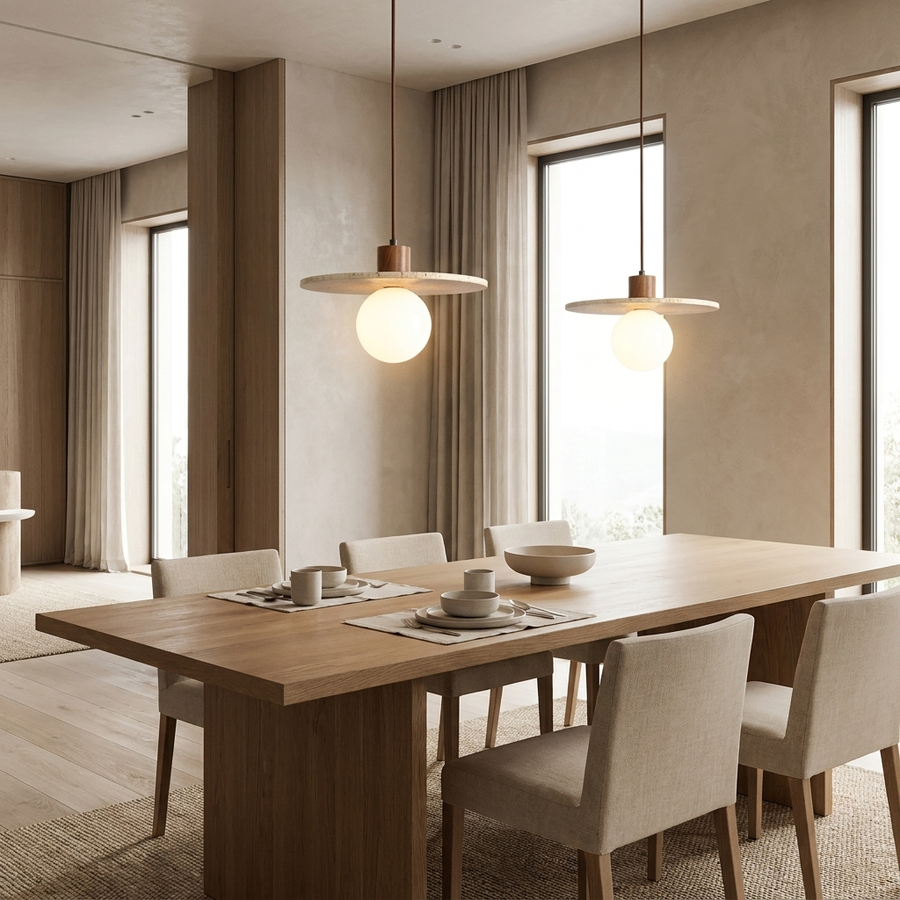
Terra Disk Pendant Light
A travertine disk suspended over a table, bringing the same natural texture overhead.
$179.99
Discover →FAQ
What is the difference between alabaster and travertine?
Does alabaster lighting really glow?
Is travertine lighting the same as alabaster lighting?
Why do natural stone light fixtures look different from the photos?
How do you clean an alabaster or travertine light fixture?
Should I choose alabaster or travertine for my space?
Read Next


Explore Natural Stone Lighting
Alabaster and travertine fixtures, each one naturally varied -- browse what's new.
Explore New Arrivals →